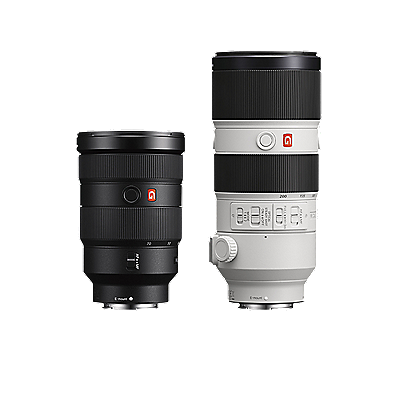
The lens name indicates the focal length, F-value, and other information about the lens. Select the type of lens type you have for more information:
For E-mount lenses

- Focal length: When this value is a range, the lens is a zoom lens. When this value is a single number, the lens is a single focus lens.
- F-value which indicates how fast the lens is based on aperture settings.
- F-value indicated by the name of a lens is the F-value when the lens is wide open (the minimum F-value).
- The smaller the value, the faster the lens is.
- The prefix of an E-mount lens is SEL (e.g. SEL2870).
The typical codes used at the beginning of an E-mount lens’ name:
- E denotes a lens for a camera with an APS-C size image sensor. When the lens has been mounted on a camera which is equipped with a 35 mm full-frame image sensor, the angle of view is cropped to APS-C size.
- PZ denotes power zoom capability.
- FE is a code for a lens compatible with a camera taht has a 35 mm full-frame image sensor.
- Sonnar T*, Vario-Sonnar T*, Distagon T*, or Planar T* is inserted at the beginning of a Carl Zeiss® lens’ name.
The typical codes used at the end of an E-mount lens’ name:
- G denotes the Gold standard and identifies a Sony G lens.
- GM denotes a G Master or Gold Master lens and identifies the G Master series lenses which is an improved version of the G lenses.
- ZA denotes Zeiss Alpha and identifies a Carl Zeiss Lens.
- Macro denotes a macro lens.
- OSS is Optical Steady-Shot which is an in-lens optical camera-shake compensation function.
- LE stands for Light Edition lens. This edition achieves lighter weight and downsizing.
- II, 2 the number 2 at the end indicates that it is the second generation.
Examples:
- FE 24-70mm F2.8 GM II (SEL2470GM2)
- E PZ 16-50mm F3.5-5.6 OSS II (SELP16502)
For A-mount lenses

- Focal length. When this value is a range, the lens is a zoom lens. When this value is a single number, the lens is a single focus lens.
- F-value which indicates how fast the lens is based on aperture settings.
- The F-value indicated by the name of a lens is the F-value when the lens is wide open (the minimum F-value).
- The smaller the value, the faster the lens is.
- The name of an A-mount lens starts with SAL (e.g. SAL55300).
The typical codes used at the beginning of a A-mount lens’ name:
- DT denotes a lens for a camera with an APS-C size image sensor. A lens whose name has no DT at the beginning is compatible with a camera that has a 35 mm full-frame image sensor.
- Sonnar T*, Vario-Sonnar T*, Distagon T*, or Planar T* is inserted at the beginning of a Carl Zeiss® lens’ name.
The typical codes used at the end of a A-mount lens’ name:
Note: SSM and SAM are types of autofocus drive control systems.
- G denotes the Gold standard and identifies a Sony G lens.
- ZA denotes Zeiss Alpha and identifies a Carl Zeiss Lens.
- Macro denotes a macro lens.
- Fisheye is a fisheye lens.
- Types of lens auto focus drive control systems:
- SSM denotes a Super Sonic wave Motor.
- SSM II is an improved version of SSM.
- SAM denotes a Smooth Autofocus Motor.
- II, 2 The number 2 at the end indicates that it is the second generation.
Example:
- 300mm F2.8 G SSM II (SAL300F28G2)
- 70-300mm F4.5-5.6 G SSM II (SAL70300G2)
Notes:
- The firmware of the lens or camera body may need to be updated.
- Some functions are not available.
- Some precautions or limitations apply when using the products.
- Refer to the Lens - Compatibility Information page for additional lens and compatibility information.
- For more information on F-stop and aperture modes, refer to the Aperture (F-number) and A-Mode article.